

Table of Contents
- Why Choosing Safe Dog Toys Matters
- Step 1: Match Toys to Your Dog's Size and Breed
- Step 2: Identify Your Dog as an Aggressive Chewer
- Step 3: Inspect Materials and Avoid Toxic Substances
- Step 4: Use the Fingernail Test for Toy Hardness
- Step 5: Create a Dog Toy Safety Inspection Checklist
- Step 6: Learn How to Prevent Dog Choking Hazards
- Supervise Play and Rotate Toys for Mental Health
- Frequently Asked Questions
Last Updated: September 28, 2026
Why Choosing Safe Dog Toys Matters
Choosing safe dog toys guide 2026 prevents injuries, choking, and toxic exposure. Dogs explore the world through their mouths, so what they chew on directly affects their well-being.
A toy that's too hard can crack teeth. One with small parts can cause intestinal blockages. Materials with harmful chemicals can poison your dog over time.
This guide covers how to choose safe dog toys for your dog's age, size, and chewing style, what to look for, what to avoid, and how to inspect toys before play.
Step 1: Match Toys to Your Dog's Size and Breed
The first rule of toy safety is size matching. A toy that's perfect for a Great Dane is a choking hazard for a Chihuahua.
Match toy dimensions to your dog's mouth. The toy should be large enough that your dog cannot fit the entire thing in their mouth. If your dog can swallow it whole, it's too small.
Toy breeds like Yorkies and Pomeranians need smaller, softer toys. Large breeds like Labs and German Shepherds need bigger, more durable options.
Age matters too: puppies need softer toys for tender gums, adult dogs benefit from medium-hardness toys, and senior dogs need softer options to protect aging teeth.
PetNest Market carries the Double Action Power Chew Durable Dog Toy in X-Large (10 inches long by 2.75 inches wide) designed for dogs 50 pounds and over.

Step 2: Identify Your Dog as an Aggressive Chewer
Not all dogs chew with the same intensity. Aggressive chewers demolish toys in minutes; gentle chewers enjoy the same toy for weeks. Knowing your dog's chewing style is essential for toy selection.
Signs of an aggressive chewer:
- Destroys toys within hours or days
- Shakes toys violently side to side
- Tears stuffing out of plush toys immediately
- Splinters or cracks hard toys with their bite force
- Swallows chunks of toy material
Aggressive chewers need reinforced materials like reinforced nylon or hard rubber designed to handle power chewing. Soft plush and thin rubber toys will fail quickly.
Gentle chewers can enjoy a wider range of toys, including softer plush options. They're less likely to break toys apart and create choking hazards.

If unsure, start with a durable toy and watch closely to determine whether your dog is a power chewer or takes a gentler approach, then adjust selection accordingly.
Step 3: Inspect Materials and Avoid Toxic Substances
What a toy is made from matters as much as how it's made. Some materials are safe; others contain chemicals that can poison your dog. Toy labels often don't clearly disclose material composition.
Materials to avoid:
- PVC plastic (contains phthalates linked to endocrine disruption)
- Lead-based paint or heavy metal dyes
- Adhesives with formaldehyde
- Plastic toys that break into sharp shards
- BPA-containing plastics
- Vinyl toys without phthalate-free certification
Safe materials include:
- Natural rubber (latex-free options available)
- Reinforced nylon designed for pet use (FDA-compliant grades)
- Non-toxic cotton fabric
- Durable polyester blends tested for pet safety
- TPE (thermoplastic elastomer, phthalate-free)
- Food-grade silicone
How to identify BPA-free and phthalate-free plastics:
Manufacturers aren't required to list phthalate content, but you can identify safer plastics by:
- Look for explicit certifications. The label should state "phthalate-free," "BPA-free," or "PVC-free." If absent, assume the material may contain these chemicals.
-
Check the plastic resin code. On the bottom or back of plastic toys, you'll find a number inside a triangle (1-7). Codes 3 and 7 are most likely to contain phthalates or BPA:
- Code 1 (PET): Generally safe
- Code 2 (HDPE): Generally safe
- Code 3 (PVC): Often contains phthalates, avoid
- Code 5 (PP): Generally safe
- Code 7 (Other): May contain BPA, avoid unless labeled otherwise
- Verify third-party testing. Ask the retailer or manufacturer if toys have passed CPSC testing for lead and phthalates, or if testing results are available.
- Research the manufacturer. Established pet toy companies are more likely to use safe materials. Toys from unknown manufacturers or unregulated sources are higher risk.
- Avoid toys with strong chemical smells. A strong plastic odor indicates off-gassing of VOCs or phthalates. If a new toy smells strongly, air it out for 24-48 hours before use or return it.
Read toy labels for explicit statements like "non-toxic," "BPA-free," "phthalate-free," or "PVC-free." Avoid vague language like "safe" or "pet-friendly" without certifications. Contact the manufacturer if they won't disclose materials or testing results.
Consumer Product Safety Commission guidance on pet product safety and phthalate regulations
FDA guidance on plastic materials in pet products
Step 4: Use the Fingernail Test for Toy Hardness
One of the simplest safety checks is the fingernail test. This tells you whether a toy is too hard for safe chewing.
Press your fingernail firmly into the toy's surface. If your nail leaves an indent, the toy is soft enough. If not, the toy is too hard and can crack your dog's teeth.
Re-test older toys monthly, as they can harden over time or develop weak spots.
Step 5: Create a Dog Toy Safety Inspection Checklist
Before every play session, do a quick safety check to catch problems before they become emergencies.
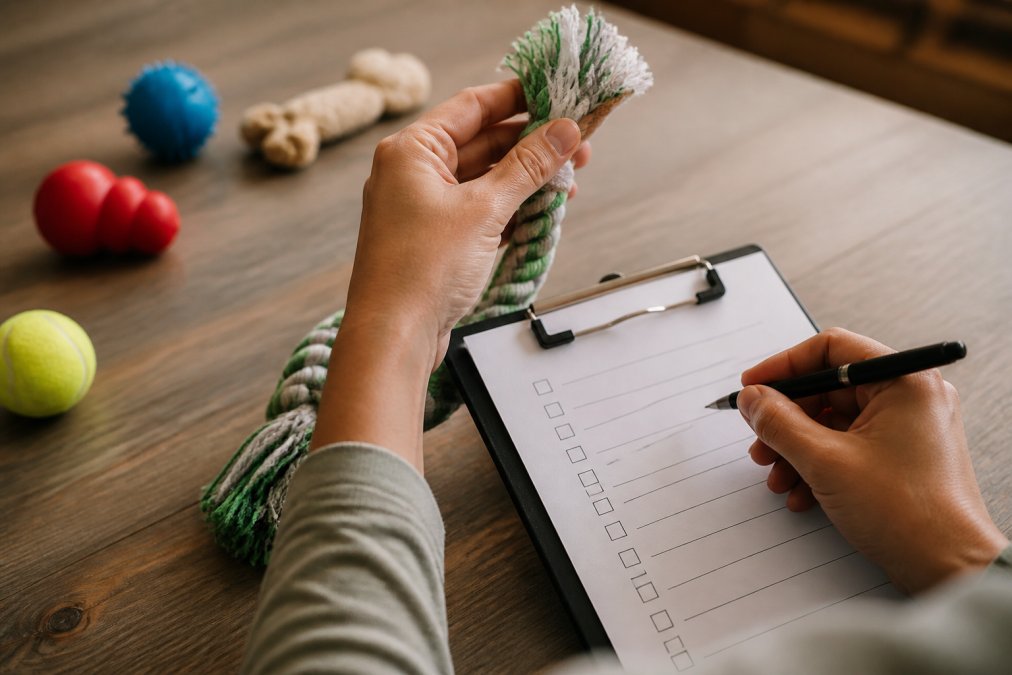
Use this checklist every time:
- Check for loose or missing parts (squeakers, bells, eyes)
- Look for tears, holes, or punctures in the fabric
- Feel for sharp edges or splinters
- Confirm no pieces have broken off since last inspection
- Verify the toy still passes the fingernail test
- Check for mold or discoloration that suggests contamination
- Ensure stuffing hasn't come loose where your dog can swallow it
Keep a written checklist near toy storage. Discard any toy that fails inspection immediately.
Store toys in one place so you can inspect them all systematically, such as PetNest Market's Canvas Pet Toy and Accessory Storage Bin.
| Inspection Item | What to Look For | Action if Failed |
|---|---|---|
| Loose parts | Squeakers, bells, eyes that move or detach | Remove toy from rotation |
| Tears or holes | Openings in fabric or seams | Discard toy |
| Sharp edges | Splinters, rough spots, broken pieces | Sand smooth or discard |
| Stuffing | Exposed or loose filling | Sew closed or discard |
| Hardness | Indents with fingernail test | Keep in rotation |
| Discoloration | Mold, stains, or color changes | Discard toy |
Step 6: Learn How to Prevent Dog Choking Hazards
Choking happens fast. Most choking incidents involve toys with small detachable parts or toys that break apart during play.
Common choking hazards:
- Squeakers that come loose from plush toys
- Plastic eyes sewn onto stuffed animals
- Bells attached with weak fasteners
- Toy pieces that break off during aggressive chewing
- Rope toys that fray and shed fibers
- Toys with holes large enough for teeth to catch
Remove any toy with loose parts immediately. Avoid rope toys for aggressive chewers, they fray and create swallowable fibers. Supervise play with new toys for the first few sessions to understand how your dog interacts with them. Never leave your dog alone with an unvetted toy.
Supervise Play and Rotate Toys for Mental Health
Supervise play to:
- Catch toy damage before it becomes dangerous (fraying, loose parts, cracks)
- Prevent aggressive toy guarding and resource-guarding behavior
- Interrupt play if your dog is trying to swallow pieces or showing signs of choking
- Notice which toys your dog enjoys versus which cause stress
Age-specific supervision and toy safety:
Puppies (8 weeks to 6 months): Puppies are the highest-risk group for toy-related injuries. Supervise all play sessions closely and never leave a puppy alone with a toy. Choose soft rubber teething rings, rope toys (only under supervision), and plush toys without squeakers or plastic eyes. Avoid hard plastic or rubber toys that can crack puppy teeth. Rotate teething toys every 2-3 days and keep 4-5 in rotation.
Toy rotation for mental health and safety:
The rotation system:
- Divide toys into groups of 3-4 toys each
- Keep one group out for active play
- Store other groups in a closed bin or cabinet
- Swap groups every 5-7 days
- When toys are in storage, inspect them thoroughly for damage
- Discard any toy that fails inspection before rotating it back in
Recognizing when a toy is no longer safe:
Signs a toy is no longer safe, regardless of age:
- Visible cracks, splits, or splintering
- Loose or missing squeakers, bells, or plastic eyes
- Exposed stuffing or foam that your dog can ingest
- Discoloration or mold growth
- Pieces that break off during play
- Hardening or brittleness (rubber toys can harden over months)
- Seams that are coming apart
- Any sharp edges or rough spots
Frequently Asked Questions
What are the safest materials for safe dog toys?
The safest dog toy materials include natural rubber, reinforced nylon, and non-toxic plush fabric. Look for toys labeled BPA-free and phthalate-free. Avoid materials that splinter easily, contain toxic dyes, or have removable parts like plastic eyes or beads. Toys made from durable construction that won't break apart during chewing are ideal for most dogs. Always check product labels for certifications and material transparency.
How can I tell if a dog toy is the right size for my pet?
A properly sized toy should be larger than your dog's mouth to prevent swallowing. The toy should fit comfortably in your dog's mouth without forcing it open too wide. Test by holding the toy next to your dog's mouth, if it could fit entirely inside, it's too small. Always choose size-appropriate toys based on your dog's weight and breed to prevent choking hazards.
How often should I inspect my dog's toys for wear and tear?
Inspect toys at least once weekly, and more frequently if your dog is an aggressive chewer. Look for loose threads, cracks, splintering, or pieces that could break off. Remove any toy showing signs of damage immediately to prevent ingestion risk. For toys used daily during supervised play, check them before and after each play session. Rotate toys regularly and retire worn items before they become a safety hazard.
What should I do if my dog swallows a piece of a toy?
Contact your veterinarian immediately if you suspect your dog has swallowed a toy part.