

Table of Contents
- Understanding Anxiety in Grooming
- What You'll Need Before Starting
- How to Desensitize Your Dog to Grooming Tools
- Building Trust and Positive Associations
- Positive Reinforcement Grooming Techniques That Work
- Step-by-Step Home Grooming Process
- Using Calming Aids for Dog Grooming
- Common Grooming Mistakes to Avoid
- Frequently Asked Questions
Last Updated: September 25, 2026
Understanding Anxiety in Grooming
Grooming anxious dogs at home is manageable with the right approach, even if your dog shakes, hides, or resists brushes and clippers. Anxiety stems from unfamiliar sensations, loud noises, past negative experiences, or fear of restraint and paw handling. Most anxious dogs respond well to gradual desensitization and positive reinforcement at home.
What You'll Need Before Starting
Essential grooming tools:
- Soft-bristled brush or comb
- Dog nail clippers or grinder
- Dog shampoo and conditioner
- Towels for drying
- Treats your dog loves
- A grooming table or mat for stability
Optional items: non-slip mat, dog-safe calming aids, grooming loop or restraint (used gently, never forcefully)
The American Kennel Club recommends having a designated grooming space where your dog feels safe. A bathroom or laundry room works well, somewhere enclosed and familiar.
PetNest Market carries grooming tools designed with anxious dogs in mind. The Silicone Pet Grooming Fur Brush ($9.90) features soft bristles that massage rather than pull, making brushing feel less threatening. Its non-slip handle gives you control while keeping your hands steady during nervous moments.
How to Desensitize Your Dog to Grooming Tools
Desensitization introduces tools slowly so your dog learns they're harmless. It works through "threshold management", keeping interactions below your dog's anxiety threshold. As your dog repeats calm experiences, the threshold rises, allowing more intense stimuli without triggering fear.

Stage 1: Environmental familiarity (3-7 days)
Leave grooming tools in your dog's living space without handling. Let your dog investigate at their own pace without force.
Readiness to advance: Your dog sniffs or approaches tools without hesitation and displays relaxed body language when tools are visible.
If your dog stalls here: Extend 1-3 weeks, reward any approach with treats, or move tools farther away.
Stage 2: Scent and tactile pairing (5-10 days)
Hold a brush near your dog's nose, then immediately give a high-value treat. Do this 3-5 times daily in 30-second interactions. Then touch grooming-relevant areas (ears, paws, face, belly) with your bare hand for 5-10 seconds, then reward.
Readiness to advance: Your dog actively seeks the brush, shows no tension during paw or ear touches, and displays eager anticipation of treats.
If your dog stalls here: Hold paws for 2 seconds, release, reward. Gradually extend to 5-10 seconds. Never restrain; let them pull away.
Stage 3: Tool contact without use (7-14 days)
Hold the brush against your dog's back for 1-2 seconds, remove it, and reward. Repeat 5-10 times per session, 1-2 times daily. For clippers, hold near the paw without opening. For a dryer, hold unplugged near the body.
Readiness to advance: Your dog remains calm when the tool touches their body with no flinching or muscle tension.
If your dog stalls here: Extend 1-2 weeks, use higher-value treats, practice 2-3 times daily in 1-minute sessions.
Stage 4: Gentle tool activation (10-21 days)
For brushes, make one slow, light stroke down your dog's back, stop, and reward. For clippers, hold the paw and squeeze very slightly so your dog hears the sound and feels minimal pressure, then reward. For a dryer, turn it on at lowest speed and heat, hold 3 feet away for 2-3 seconds, then reward. Gradually move closer over sessions.
Readiness to advance: Your dog shows no startle response to tool sounds and maintains relaxed body language.
If your dog stalls here: Play recordings of clipper or dryer sounds at low volume during meals.
Stage 5: Building duration and intensity (ongoing)
Hair Removal & Massage Electric Pet →
Once your dog tolerates gentle tool use, gradually increase the duration and intensity. Brush 3-5 strokes instead of one. Trim one nail instead of just feeling pressure. Run the dryer for 5 seconds instead of 2. Increase by small increments every 3-5 days, only if your dog remains calm.
Readiness to advance: Your dog seeks out grooming sessions, shows no stress signals during or after, and remains calm for the entire session duration.
If regression occurs: If your dog suddenly shows anxiety after progressing, you've advanced too quickly. Drop back to the previous stage for 1-2 weeks, then progress more slowly. Regression is normal and does not mean failure, it means you've found your dog's current threshold.
Keep a simple log of each session. Most anxious dogs complete desensitization in 4-8 weeks, but some require 12 weeks or longer.
Building Trust and Positive Associations
Touch grooming-relevant areas daily, followed by treats and praise. Use high-value treats before, during, and after grooming. Groom at the same time and location each day. Keep your energy calm and speak in a quiet, encouraging tone.
Positive Reinforcement Grooming Techniques That Work
Use a marker word like "yes!" to mark calm behavior (standing still, relaxed ears, stopped trembling), followed immediately by a treat. Break grooming into tiny steps, rewarding each one.
Session structure for success:
| Step | Duration | What to Do |
|---|---|---|
| Warm-up | 1-2 minutes | Light petting and treats |
| Grooming work | 2-5 minutes | Actual brushing or nail work |
| Cool-down | 1-2 minutes | Praise and calm petting |
| Reward | Immediate | High-value treat or play |
Step-by-Step Home Grooming Process
Now that you've desensitized your dog, follow this process to groom anxious dogs at home successfully.
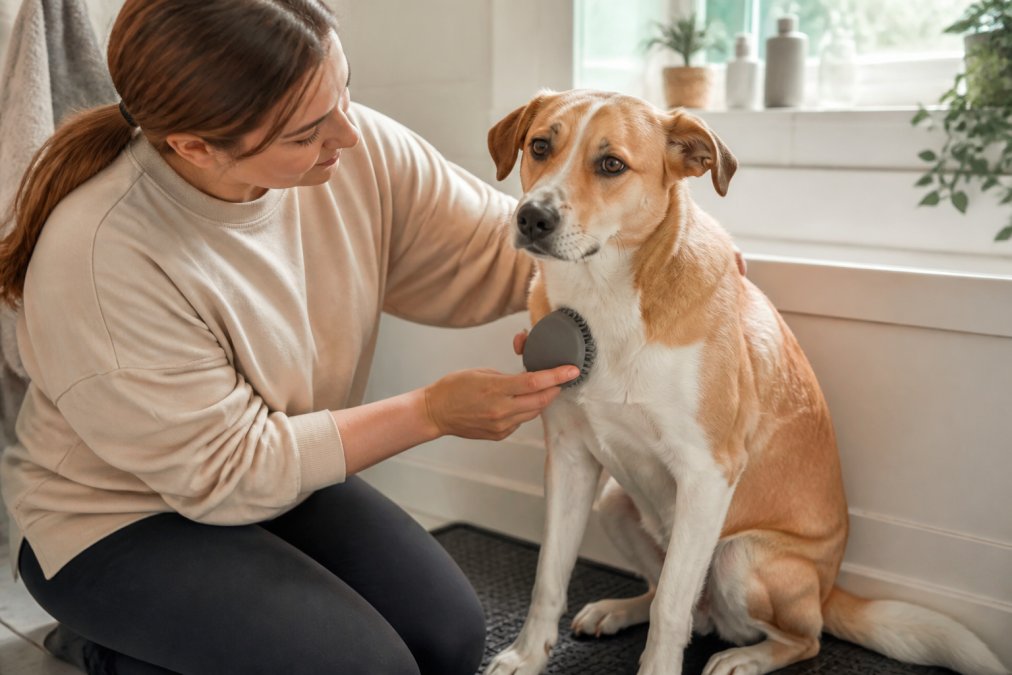
Brushing and Detangling
Start with brushing, it's the least invasive. Settle your dog on a mat, begin with tolerated areas, brush in the direction of hair growth with gentle strokes, work toward sensitive areas only after relaxation, reward frequently, and stop at stress signals.
The Hair Removal & Massage Electric Pet Spray Comb ($5.76) offers a gentler alternative to traditional brushes. The built-in spray moisturizes while soft bristles remove loose hair without harsh pulling. For anxious dogs, the massage effect can feel soothing rather than threatening.
For mats and tangles, work gently from outside inward, or trim carefully rather than cause pain.
Trimming Nails for Anxious Dogs
Hold the paw gently, extend one nail at a time, trim only the clear part (avoiding the quick), and reward after each nail. Many anxious dogs prefer a grinder to clippers. Trim 2-3 nails per session in multiple short sessions rather than one long session.
Bathing and Drying
Fill tub with 2-3 inches of lukewarm water, wet gradually starting with back legs, avoid spraying the face, apply shampoo, rinse thoroughly, and reward throughout. Towel dry first, then use a dog dryer on low heat and speed if tolerated, or air dry. For anxious dogs, air or towel drying alone is acceptable.
Using Calming Aids for Dog Grooming
Calming aids can support desensitization and positive reinforcement. Options include calming treats (L-theanine, chamomile), pheromone products, anxiety wraps, and soft music or white noise. Use when your dog shows severe anxiety despite consistent training. Consult your veterinarian before using any supplement.
Common Grooming Mistakes to Avoid
Prevention-focused mistakes:
Mistake 1: Rushing desensitization, Rushing creates lasting fear associations. Mistake 2: Grooming when stressed, Stop at the first stress signal. Mistake 3: Using punishment, Use positive reinforcement only. Mistake 4: Ignoring body language, Trembling, panting, lip licking, yawning, tucked tail, or pinned ears signal stress. Mistake 5: Inconsistent handling, Stick with one approach. Mistake 6: Skipping the warm-up, Always start with 1-2 minutes of gentle petting and treats.
Intervention strategies when anxiety escalates:
Scenario 1: Your dog refuses to cooperate (avoidance, hiding, freezing)
Refusal signals that anxiety threshold has been exceeded. Stop all grooming, create distance, and allow your dog to calm down.
Scenario 3: Your dog snaps or bites during grooming
Possible causes:
- Medical pain: Clipper burn, mat pulling, or nail quick hits. A vet exam can rule out skin conditions or infections.
- Sensory sensitivity: Heightened sensitivity to sounds, textures, or touch. Air drying may replace dryer use.
- Trauma history: Rescue dogs may need 12-16 weeks of desensitization.
- Medication side effects: Discuss new medications with your veterinarian.
Frequently Asked Questions
What are the signs that my dog has grooming-related anxiety?
Signs include trembling, excessive panting, trying to escape, whining, ears pinned back, and tension in the body. Some anxious dogs may freeze or become aggressive when they see grooming tools. Recognizing these behaviors early helps you adjust your approach before the anxiety worsens. Starting with short, calm sessions allows you to observe your dog's specific triggers.
How do you groom an unwilling dog at home?
Break grooming into very short sessions (5-10 minutes) and reward calm behavior with high-value treats and praise. Introduce each tool separately without using it first, letting your dog sniff and investigate. Use gentle, positive reinforcement techniques and never force the process. If your dog shows extreme fear or aggression, consult your vet or a professional groomer trained in handling anxious dogs.
What tools work best for grooming anxious dogs?
Soft-bristled brushes, rechargeable electric combs with spray features, and quiet trimmers are ideal because they're less intimidating. The Silicone Pet Grooming Fur Brush ($9.90) offers a gentle massage-like experience that many anxious dogs tolerate well. For nail trimming, quiet electric clippers reduce stress compared to manual ones. Introduce each tool gradually during calm moments before actual grooming sessions.
How long does it take to desensitize a dog to grooming?
Desensitization typically takes 2-4 weeks with consistent daily practice, though some dogs progress faster. Start with 2-3 minute sessions where you simply show and handle tools without using them. Gradually increase exposure and duration as your dog becomes comfortable. Patience and consistency matter more than speed; rushing the process can reinforce anxiety rather than resolve it.